Content
The Birth of Anonymity
The origins of the Venetian Carnival are shrouded in the mists of time, with the first recorded mention dating back to 1094. However, it wasn’t until two centuries later that the state officially declared it a public festival. The government of La Serenissima, the “Most Serene Republic of Venice,” was shrewd. They understood that a period of sanctioned revelry, where the rigid social hierarchy was temporarily dissolved, acted as a crucial safety valve. It allowed the populace to vent frustrations and indulge in fantasies, ultimately preserving social order for the rest of the year. The mask, or maschera, was the key that unlocked this temporary utopia. By wearing a mask, a servant could jest with a Duke, and a noblewoman could slip into a rowdy tavern unnoticed. It was the ultimate social equalizer. This anonymity wasn’t just for fun; it had practical and sometimes illicit applications. It allowed for secret romantic liaisons, clandestine business dealings, and even political espionage. The mask became so integral to Venetian life that its use extended far beyond the Carnival season, with people donning disguises for a significant portion of the year to conduct their daily affairs in privacy.The Venetian government eventually had to regulate the use of masks due to the chaos they could cause. Laws were enacted over the centuries to control their use. For instance, men were forbidden from dressing as women and entering convents, and masks were banned from being worn inside gambling houses after dark to prevent cheating and disputes from escalating anonymously. Wearing masks during most religious holidays was also strictly prohibited.
A Catalogue of Characters
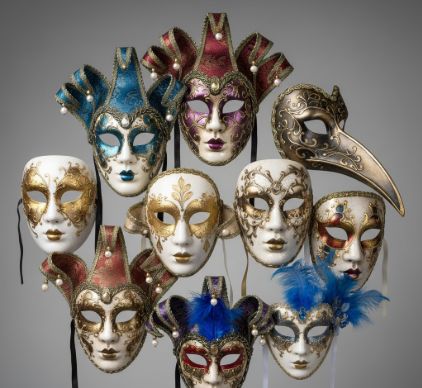
Venetian masks were not generic disguises. Each type had its own name, history, and symbolic meaning, often stemming from traditions of Italian theater or the practicalities of Venetian society. They were crafted by skilled artisans known as mascherari, who held a respected position in the city’s guilds. These masks fall into several distinct categories, each telling a part of Venice’s story.The Practical and Political: Bauta
Perhaps the most iconic and widespread mask was the Bauta. This was not just a mask but a full costume, consisting of a stark white, full-face mask with a prominent, squared-off jawline, a black tricorn hat, and a dark cloak called a tabarro. Its design was a work of genius. The jutting chin ensured the wearer’s voice was slightly disguised, but more importantly, it was shaped to allow one to eat and drink without having to remove it. This practicality made it incredibly popular for all-night festivities. The Bauta was a symbol of civic life. It was considered the quintessential citizen’s disguise, worn by both men and women of all social classes. In a fascinating blend of revelry and governance, citizens were sometimes required by law to wear the Bauta when attending certain political decision-making events, guaranteeing that votes were cast based on merit rather than personal influence or prejudice.The Alluring Mystery: Moretta
In stark contrast to the utilitarian Bauta was the Moretta, or “dark one.” This was a small, strapless, oval mask covered in black velvet, favored exclusively by women. It possessed a unique and rather demanding feature: it was held in place by a small button on the inside that the wearer had to clench between her teeth. This rendered her completely silent. The Moretta created an aura of intense mystery and eroticism. A woman wearing it could only communicate with her eyes and gestures. If she wished to speak to a suitor, she had to remove the mask, a deliberate and often suggestive act. It was a tool of flirtation and power, placing the control of the interaction entirely in the woman’s hands.The Haunting Echoes of History: Medico della Peste
One of the most striking and recognizable masks is the Medico della Peste, or the Plague Doctor. With its hollow, crystal-covered eyeholes and a long, beak-like nose, it has a distinctly macabre and unsettling appearance. Unlike many other masks born from festivity, its origins lie in grim reality. This mask was not originally intended for the Carnival at all. It was designed in the 17th century by the French physician Charles de Lorme as a piece of protective medical equipment for doctors treating plague victims. The long, hollow beak was filled with aromatic substances like lavender, mint, and camphor, which were believed to purify the air and protect the doctor from the “miasma” thought to spread the disease. The full costume included a long black coat, gloves, and a staff to examine patients from a distance. Its later adoption into the Carnival is a classic example of Venetians transforming a symbol of terror and death into a memento mori, a reminder of mortality amidst the celebration of life.The Theatrical Troupe: Commedia dell’Arte
A huge number of popular masks are direct imports from the world of Commedia dell’Arte, a form of improvisational street theater that flourished in Italy from the 16th to the 18th century. These masks represented stock characters, each with a defined personality and social role.- Arlecchino (Harlequin): A nimble and acrobatic servant, his mask is typically black with ape-like features and a large bump on the forehead, symbolizing his devilish wit.
- Colombina (Columbine): A clever and flirtatious maidservant, often the only sane character. Her mask is a half-mask, covering only her eyes, nose, and upper cheeks, and is often lavishly decorated with gold, silver, and feathers.
- Pantalone: A greedy, lecherous old merchant, representing the Venetian establishment. His mask features a long, hooked nose, prominent eyebrows, and a perpetually sour expression.
- Zanni: A generic servant character, usually foolish or clownish. The Zanni mask is notable for its exceptionally long nose, with the length often corresponding to the character’s level of stupidity.