In a world where maps faded into monstrous illustrations at the edges of the known, the idea of the Far East was a tapestry woven from rumor, myth, and the whispers of traders. For most 13th-century Europeans, lands like Cathay (China) and the Indies were places of fantasy, home to untold riches and unimaginable wonders. It was into this world of mystery that a young Venetian merchant, a mere seventeen years of age, stepped forth on a journey that would not only define his life but would also permanently alter Europe’s perception of the world. His name was
Marco Polo, and his story is one of the greatest travel sagas ever told.
The adventure did not begin with Marco alone. It was a continuation of a family enterprise. His father, Niccolò, and his uncle, Maffeo Polo, were seasoned merchants who had already traversed the perilous land routes to the East. They had spent years away, even meeting the mighty Mongol ruler,
Kublai Khan, grandson of the formidable Genghis Khan. They returned to Venice in 1269 with a mission from the Khan himself: to bring back a hundred wise men of the Christian faith to share their knowledge and holy oil from the lamp at the Holy Sepulchre in Jerusalem. When they set out again in 1271, young Marco joined them, his eyes wide with the promise of adventure.
The Long and Winding Road to Cathay
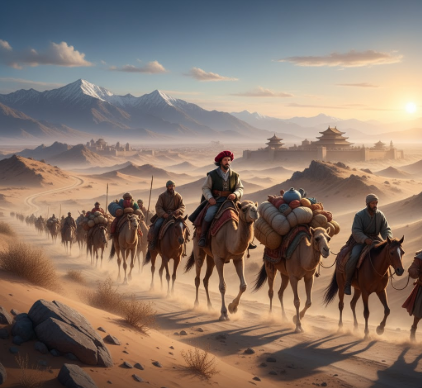
Their path was not a simple one. It was a grueling three-and-a-half-year odyssey along the legendary network of trade routes collectively known as the
Silk Road. From Venice, they sailed the Mediterranean to Acre, a crusader port in the Levant. From there, they plunged into the heart of Asia. They journeyed through Persia, with its bustling cities and skilled artisans, and navigated the treacherous mountain passes of the Pamirs, a region so high and desolate that Marco would later describe it as the “Roof of the World.”
The greatest challenge lay ahead: the vast and unforgiving Gobi Desert. For weeks, their caravan plodded through a landscape of shifting sands and stark horizons, where the sun was a merciless hammer by day and the cold was biting at night. Marco’s later accounts speak of mirages and strange sounds, spirits of the desert that were said to lead travelers astray. It was a test of endurance, a trial by landscape that weeded out the weak and rewarded the resilient. They encountered diverse cultures, witnessed strange customs, and navigated the complex politics of the territories under the sprawling Mongol Empire.
Arrival at the Court of the Great Khan
In 1275, after years of travel, the Polos finally reached their destination: the summer palace of Kublai Khan at Shangdu, or Xanadu, a place that would later be immortalized in poetry. The sight that greeted them was beyond anything a European could have imagined. They had left a world of stone castles and small, warring city-states and arrived in the heart of a vast, highly organized, and fabulously wealthy empire. The Khan’s court was a spectacle of opulence, discipline, and power. Marco, now a young man fluent in several languages including Persian, quickly captivated the great ruler.
While some modern historians debate the specifics of Marco Polo’s account, his book, “The Travels of Marco Polo,” became one of the most influential documents of the late Middle Ages. It was a primary source of information about the East for Europeans for centuries. Christopher Columbus himself owned a heavily annotated copy, which directly inspired his belief that he could reach the Indies by sailing west.
Kublai Khan was a man of great curiosity and intellect. He was fascinated by the Polos’ stories of the West and impressed by Marco’s keen observational skills. Seeing the young Venetian’s potential, the Khan took him into his service. This was the beginning of a seventeen-year stay in China, during which Marco Polo was not merely a guest but an active participant in the administration of the Mongol Empire.
Seventeen Years in Service and Discovery
Marco’s life at the Khan’s court was extraordinary. He was sent on missions to distant parts of the empire, from the southern provinces of China to Burma and India. He served as an emissary, an inspector, and, by his own account, even a governor of the city of Yangzhou. These duties gave him a unique vantage point from which to observe the wonders of this advanced civilization. He was astounded by things that were utterly alien to Europe at the time.
He wrote of vast cities with populations larger than any in Europe, whose streets were planned and well-maintained. He described the use of
“black stones that burn” (coal) as a common fuel, a practice unknown in most of Europe. He was amazed by the concept of
paper money, a fiat currency backed by the sole authority of the Khan, which streamlined commerce across the immense empire. He detailed the incredibly efficient imperial postal system, a network of relay stations with fresh horses that could carry messages across thousands of miles in a matter of days. This system was the backbone of the empire’s communication and administration, a marvel of logistics.
The Perilous Journey Home
After seventeen years, the Polos grew homesick. Now wealthy and respected, they yearned to see Venice again. However, Kublai Khan had grown fond of them and was reluctant to let them leave. Their opportunity finally came in 1292. A Mongol princess, Kököchin, was to be sent to Persia to marry a ruler there, and an overland journey was deemed too dangerous. The Polos, with their extensive experience, were asked to escort her on a long sea voyage.
This final leg of their adventure was perhaps the most dangerous of all. They set sail from southern China with a fleet of fourteen ships and over six hundred people. The voyage through the South China Sea, around the tip of Southeast Asia, and across the Indian Ocean took two grueling years. They were battered by storms and plagued by disease. By the time they reached the Persian port of Hormuz, only eighteen passengers, including the princess and the three Polos, were still alive. From Persia, they finally traveled overland, reaching Venice in the winter of 1295.
They had been gone for twenty-four years. When they arrived, dressed in worn Tartar clothing and speaking Italian with a foreign accent, their own relatives did not recognize them. They were treated as impostors until, according to legend, they hosted a grand dinner, cut open the seams of their old garments, and let a river of rubies, emeralds, and diamonds spill onto the table—the incredible fortune they had amassed in the East. Their identity and their story were finally accepted.
The Legacy of a Storyteller
Marco Polo’s adventures did not end with his return. A few years later, during a naval war between Venice and its rival, Genoa, he was captured and imprisoned. It was in this Genoese prison that he met a writer of romances named Rustichello da Pisa. To pass the time, Marco dictated the entire story of his travels to Rustichello, who wrote it down. The resulting book, “The Description of the World,” or more popularly,
“The Travels of Marco Polo,” became an instant sensation.
The book opened a window onto a world of incredible scale and sophistication. It was a revelation for a Europe that was just beginning to look beyond its own borders. While many of his contemporaries dismissed his tales as fantasy—earning him the nickname “Il Milione,” or “The Man of a Million Lies”—his detailed descriptions of geography, culture, and technology would profoundly influence generations of mapmakers, merchants, and explorers. He brought the East from the realm of myth into the realm of possibility, igniting a spark of curiosity and ambition that would ultimately fuel the Age of Discovery. Marco Polo may not have discovered the East, but he revealed it to the West, and in doing so, he forever changed the map of the world in the minds of all who followed.