Content
The Battle of Salamis (480 BC): The Cradle of Western Civilization
In the 5th century BC, the mighty Persian Empire, under King Xerxes, launched a massive invasion to subjugate the fractious city-states of Greece. After burning Athens, the Persian fleet cornered the smaller, allied Greek navy in the narrow straits between the island of Salamis and the mainland. On paper, the Greeks were hopelessly outmatched, facing a force perhaps three times their size. What they had, however, was a brilliant strategist in the Athenian general Themistocles and a superior type of vessel, the trireme.Themistocles’ Cunning Plan
Themistocles understood that in the open sea, the sheer numbers of the Persian fleet would overwhelm his forces. He brilliantly lured the Persians into the confined waters of the straits. In this tight space, the Persian fleet’s numerical advantage became a liability. Their ships were cumbersome and became disorganized, crashing into each other and unable to maneuver effectively. In contrast, the more agile Greek triremes could dart in, ram the enemy vessels with their bronze-sheathed bows, and retreat before the larger ships could react. The result was a stunning and decisive victory for the Greeks.A World-Changing Outcome
The significance of the Battle of Salamis cannot be overstated. Had the Persians won, Greece would have been absorbed into their empire. The nascent concepts of democracy, philosophy, and theater that were blossoming in Athens might have been extinguished. The victory at Salamis ensured the survival of Greek independence and culture, allowing it to flourish and eventually lay the intellectual foundations for the Roman Empire and, by extension, all of Western civilization. It was a victory that echoed through millennia.The Battle of Actium (31 BC): The Birth of the Roman Empire
After the assassination of Julius Caesar, the Roman world was plunged into a series of brutal civil wars. The final conflict pitted two of its most powerful figures against each other: Caesar’s adopted son, Octavian, and his former general, Mark Antony, who had allied himself with the Egyptian queen, Cleopatra. Their struggle for supreme control of Rome culminated in a massive naval battle off the coast of Actium in western Greece.While often romanticized as a battle for the love of Cleopatra, the Battle of Actium was a cold, calculated power play. For Octavian, it was about consolidating his control and ending the destructive civil wars. For Antony, it represented a chance to shift the center of Roman power eastward, with Alexandria as its new capital.
Clash of Fleets and Ideologies
Antony and Cleopatra’s fleet was composed of large, heavy quinqueremes, essentially floating fortresses designed for boarding actions. Octavian’s fleet, commanded by his brilliant admiral Marcus Agrippa, consisted of smaller, more agile Liburnian galleys. Agrippa’s ships were faster and could easily outmaneuver Antony’s behemoths. They surrounded the larger vessels, using archers and catapults to rain fire down upon them and ramming them at will. Midway through the battle, seeing the tide turning, Antony and Cleopatra broke through the line and fled back to Egypt, leaving the bulk of their fleet to be destroyed or surrender.The Dawn of a New Era
The victory at Actium was absolute. It ended the civil wars and left Octavian as the undisputed master of the Roman world. He would soon be granted the title Augustus, becoming the first Roman Emperor. The battle marked the definitive end of the Roman Republic and the beginning of the Roman Empire, ushering in the Pax Romana—two centuries of relative peace and stability that allowed Roman culture, law, and engineering to spread across the known world.The Battle of Trafalgar (1805): Britain Rules the Waves
In the early 19th century, Napoleon Bonaparte’s ambition seemed limitless. He had conquered most of continental Europe, and only Great Britain stood in his way. To defeat his nemesis, Napoleon needed to cross the English Channel, an invasion that required neutralizing the formidable British Royal Navy. The decisive confrontation came on October 21, 1805, off Cape Trafalgar on the Spanish coast, where the combined fleets of France and Spain met the British fleet under the command of Vice-Admiral Horatio Nelson.Nelson’s Audacious Tactic
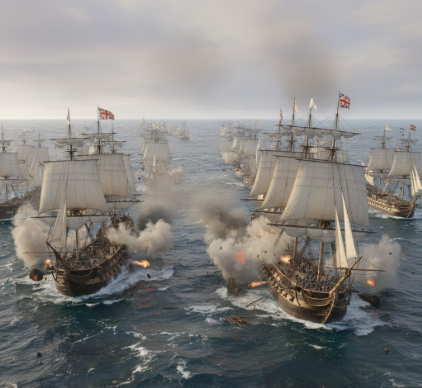
Traditional naval tactics of the era dictated that opposing fleets form parallel lines and blast away at each other. Nelson, a master tactician, threw out the rulebook. He divided his smaller fleet into two columns and sailed them perpendicularly into the Franco-Spanish line. This high-risk maneuver, known as “crossing the T,” exposed his lead ships to concentrated fire but allowed him to break the enemy line in two places, isolate sections of their fleet, and create a chaotic melee where superior British gunnery and seamanship would prevail.The victory at Trafalgar was overwhelming, but it came at a great cost. Admiral Nelson was mortally wounded by a French sharpshooter at the height of the battle, his last words being “Thank God, I have done my duty.” His death cemented his status as Britain’s greatest naval hero. The battle shattered Napoleon’s naval power and ended any realistic prospect of an invasion of Britain.The impact of Trafalgar was profound. It secured over a century of undisputed British naval supremacy. This dominance allowed Britain to build a global empire, protect its vast trade networks, and play a decisive role in world affairs well into the 20th century. The phrase “Britannia rules the waves” became a reality, largely thanks to this single, brutal afternoon of fighting.