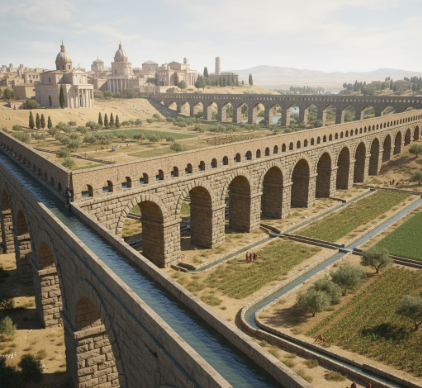
Imagine a world where the rhythm of life is dictated by a single, often unreliable, source of water. A world where cities cannot grow beyond the reach of a local river or spring, where sanitation is a foreign concept, and where public health is a constant, desperate gamble. This was the reality for most of civilization for millennia. Then came the Romans. With their unparalleled engineering prowess, they didn’t just find water; they commanded it, bending it to their will across vast distances. The Roman aqueducts were more than just conduits for water; they were the arteries of an empire, fundamentally reshaping urban life, public health, and technology in ways that still echo today.
Before the aqueducts, Rome itself was dependent on the muddy Tiber River and local wells. As the city swelled with people, this supply became woefully inadequate and increasingly polluted. The solution, first realized in 312 BC with the Aqua Appia, was breathtaking in its ambition. Instead of moving people to water, they would move water to the people. This simple idea sparked an engineering revolution that would last for over 500 years and see the construction of eleven major aqueducts serving the capital alone, with hundreds more crisscrossing the provinces from Germany to North Africa.
The Genius of Gravity and Arches
The secret to the aqueduct’s success was a masterful understanding of a single, unyielding force:
gravity. These were not high-pressure pipes. Instead, Roman engineers, known as
architecti, meticulously surveyed the landscape to create a channel with a slight, continuous downward gradient. The average gradient was astonishingly precise, often as little as a 30-centimeter drop for every kilometer of length. This gentle slope kept the water flowing at a steady pace, fast enough to prevent stagnation but slow enough to avoid damaging the structure.
While we often picture aqueducts as soaring bridges of majestic arches, the reality is that over 80% of their length was underground. Tunnels were dug through mountains and channels were laid just below the surface to protect the water from contamination and to follow the most efficient path. The iconic, multi-tiered arches were reserved for crossing valleys and lowlands. Structures like the Pont du Gard in southern France or the Aqueduct of Segovia in Spain stand as testaments to this technique. They were not just functional; they were powerful symbols of Roman dominance over the natural world, built with stone blocks so perfectly fitted they required no mortar.
The combined length of the aqueducts serving the city of Rome is estimated to be over 500 kilometers. Astonishingly, they could deliver more than one million cubic meters (over 260 million gallons) of fresh water to the city every single day. This supplied a level of per capita water consumption that was not surpassed in many major world cities until the 20th century.
Fueling the Urban Engine
The constant, reliable flow of clean water was the lifeblood of the Roman city. It fundamentally changed what it meant to live in an urban environment. This water didn’t just go to a few wealthy homes; it was a public utility, carefully distributed through a complex system of cisterns and lead pipes (
fistulae). The water powered a lifestyle of public luxury and hygiene previously unimaginable.
The Rise of Bath Culture
Perhaps the most famous result of the aqueducts was the Roman public bath, or
thermae. These were not merely places to get clean. They were vast, opulent social complexes, often free or very cheap to enter. They contained hot, warm, and cold pools, saunas, gymnasiums, libraries, and even gardens and food stalls. The Baths of Caracalla or Diocletian in Rome could accommodate thousands of people at once. Here, citizens from different social strata could mix, conduct business, exercise, and relax. The baths became the beating heart of Roman social life, all made possible by the ceaseless flow from the aqueducts.
Sanitation and Public Health
Beyond luxury, the water brought health. The Romans understood the link between clean water and well-being. Public fountains, known as
fontes, provided constant access to drinking water for the masses. More importantly, the overflow from the aqueducts was used to continuously flush the city’s extensive sewer systems, most famously Rome’s Cloaca Maxima. This constant flushing action washed waste out of the city, drastically reducing waterborne diseases and foul odors. While their understanding of germ theory was non-existent, the practical effect was a level of public sanitation that would be lost for over a thousand years after the empire’s fall.
An Economic and Agricultural Powerhouse
The impact of Roman water management extended far beyond the city walls. In the provinces, aqueducts were critical for economic activity. They provided the water necessary for large-scale agriculture and irrigation, turning arid lands into productive farms that fed the empire’s legions and burgeoning populations. In mining operations, such as the gold mines at Las Médulas in Spain, aqueducts were used for hydraulic mining, where massive volumes of water were unleashed to wash away hillsides and expose precious metal deposits. This industrial application demonstrates that aqueducts were not just a civic amenity but a vital tool of economic exploitation and imperial expansion.
A Legacy Carved in Stone
When the Western Roman Empire collapsed in the 5th century, the sophisticated knowledge required to maintain the aqueducts was largely lost. Many fell into disrepair, and cities across Europe reverted to more primitive water sources. The great public baths were abandoned, and sanitation levels plummeted, contributing to the plagues and diseases of the Middle Ages. It’s a stark reminder of how central this technology was to the Roman way of life.
However, the structures themselves endured. Their imposing ruins inspired Renaissance engineers and architects, who studied their principles of gravity flow and arch construction. The very concept of providing a city with a large, clean, and reliable water supply as a public responsibility is a direct legacy of Roman innovation. Today, our modern water systems, with their vast reservoirs, pumping stations, and distribution networks, operate on a more advanced technological level, but they share the same fundamental goal as their ancient predecessors: to conquer distance and geography to deliver life’s most essential resource to the people. The aqueducts did more than carry water; they carried the very idea of civilization.