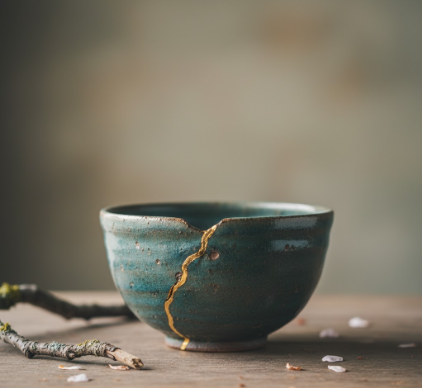
Imagine holding a ceramic tea bowl, its surface not perfectly smooth but subtly uneven, with a glaze that tells a story of the fire that forged it. Perhaps there’s a small, hairline crack near the rim, not a flaw to be hidden, but a testament to its history, a mark of its journey. This is the essence of wabi-sabi, a Japanese worldview centered on the acceptance of transience and the beauty of imperfection. It’s a concept that stands in quiet defiance of our modern obsession with polished perfection, mass-produced uniformity, and the relentless pursuit of the new.
At its heart, wabi-sabi is a philosophy that finds profound beauty in things that are imperfect, impermanent, and incomplete. It’s not just an aesthetic style; it’s a way of seeing the world and living in it. It encourages us to appreciate the organic, the humble, and the unassuming. Instead of chasing a flawless ideal, wabi-sabi invites us to find peace and harmony in the natural cycle of growth, decay, and change.
Deconstructing the Words: Wabi and Sabi
To truly grasp the concept, it helps to look at the two words that form it. Though often used together, they carry distinct, yet complementary, meanings.
Wabi: The Beauty of Simplicity
Wabi originally referred to the loneliness of living in nature, away from society. Over time, its meaning evolved to encompass a more positive interpretation: a quiet, rustic simplicity. It’s about finding satisfaction in less, appreciating the elegance of the understated, and recognizing the beauty in humble materials. Think of a single, unadorned wooden spoon, worn smooth with years of use, or the quiet solitude of a misty morning. Wabi is the inner state of contentment, free from the clutter of materialism and ego. It is the richness found in emptiness, a recognition that true quality is not about opulence but about substance and spirit.
Sabi: The Passage of Time
Sabi, on the other hand, is about the beauty that comes with age. It’s the patina on a copper roof, the faded texture of old linen, the moss growing on a stone lantern. Sabi appreciates the marks that time, weather, and use leave behind. It acknowledges that all things are transient and that this very impermanence gives them a unique, poignant beauty. It is the visible evidence of life’s journey, a story etched onto a surface. A new, shiny object may be perfect, but it lacks the depth and character—the sabi—of an object that has lived a life.
Wabi-sabi is not a decorating “style” but a mindset. It’s about cultivating an appreciation for the authentic, the modest, and the natural. This philosophy teaches us to see the world not as a collection of objects to be perfected, but as a series of moments and forms to be cherished in their natural, transient state.
The Core Principles in Practice
Wabi-sabi is guided by several key principles that reflect its core philosophy. These are not rigid rules but gentle suggestions for seeing the world through a different lens. One of the most important is
Fukinsei, or asymmetry. In contrast to the Western preference for perfect symmetry and balance, wabi-sabi finds harmony in irregularity. Nature is rarely symmetrical; a tree’s branches grow in an organic, unpredictable pattern, and a coastline is beautifully jagged. This principle suggests that imbalance and asymmetry create a more dynamic and engaging beauty.
Another principle is
Kanso, which means simplicity or clarity. It is an appreciation for clean, uncluttered spaces and objects. This is not the cold, sterile minimalism often seen today, but rather a warm, intentional simplicity that eliminates the non-essential to make room for what truly matters. Kanso focuses on the intrinsic nature of materials and form, allowing them to speak for themselves without unnecessary ornamentation. It’s about finding the essence of a thing.
Finally,
Shizen, or naturalness, is crucial. Wabi-sabi celebrates raw, unpretentious materials and forms. It avoids artificiality and embraces the inherent character of wood, stone, paper, and clay. This means allowing for rough textures, unforced shapes, and colors drawn from the earth. A wabi-sabi interior might feature exposed wooden beams, handmade pottery, and textiles made from natural fibers, all coexisting in a state of unaffected grace.
Embracing Wabi-Sabi in a Modern World
How can we apply this ancient philosophy to our fast-paced, digital lives? It starts with a shift in perspective. Instead of lamenting a scratch on your wooden dining table, you can see it as a memory of a shared meal. Rather than replacing a chipped mug, you can appreciate it as a unique part of your daily routine. The Japanese art of
Kintsugi, where broken pottery is repaired with gold lacquer, is a perfect physical manifestation of this idea. The repair is not hidden but highlighted, celebrating the object’s history and resilience.
In our homes, embracing wabi-sabi can mean choosing fewer, better things—items that have meaning, are made with natural materials, and will age gracefully. It means finding comfort in a well-worn armchair, appreciating the play of natural light in a room, and allowing for a certain degree of comfortable “messiness.” It’s an antidote to the pressure to have a perfect, show-home-ready space. It’s about creating a sanctuary that feels authentic, personal, and deeply calming.
Ultimately, wabi-sabi teaches us a profound lesson in acceptance. It encourages us to accept ourselves, others, and our world as they are: beautifully imperfect, constantly changing, and complete in their incompleteness. It is a gentle reminder to slow down, to observe closely, and to find joy and beauty in the quiet, fleeting moments of everyday life.