To walk through the old city of Cartagena is to step directly into a living postcard from the Spanish Empire. Surrounded by miles of formidable stone walls, this Caribbean port city tells a story not just of history, but of survival, ingenuity, and breathtaking beauty. The colonial architecture of Cartagena, Colombia, is more than just a collection of old buildings; it is a masterclass in design, a direct response to the tropical climate, the constant threat of pirates, and the immense wealth that once flowed through its streets. Every colorful facade, overhanging balcony, and hidden courtyard is a piece of a puzzle that, when assembled, reveals the soul of the city.
The Fortress: Built from the Sea Itself
You cannot understand Cartagena’s architecture without first understanding its purpose. Founded in 1533, it quickly became the most important Spanish port on the continent, a key storage point for gold, silver, and other plundered treasures before their perilous journey to Spain. This immense wealth made it a prime target for pirates and rival empires. The city’s response was to become a fortress. The most dominant architectural feature is, without a doubt,
Las Murallas, the massive defensive walls that encircle the old town.
Construction began in the late 16th century and took nearly two hundred years to complete. These walls are an engineering marvel, built from huge blocks of coral stone quarried from the surrounding reefs. This material gives the fortifications, and indeed many of the city’s buildings, their characteristic warm, pitted texture. Walking atop these walls today, with cannons still pointed out to sea, you feel the sheer power and permanence they were meant to project. The design wasn’t just about height and thickness; it included strategically placed bastions, sentry boxes, and tunnels, all part of a sophisticated defense system that culminated in the imposing
Castillo de San Felipe de Barajas, a sprawling fortress on a nearby hill that was said to be impenetrable.
Cartagena’s port, fortresses, and group of monuments were designated a UNESCO World Heritage site in 1984. This designation recognizes the city as one of the most extensive and complete systems of military fortifications in South America. The status underscores the global importance of preserving its unique colonial architecture for future generations.
Inside the Walls: A Symphony of Color and Shade
Once you pass through the gates of the old city, the imposing military architecture gives way to a more intimate, human-scale environment. The streets are a vibrant maze of color, with homes painted in deep ochres, vibrant blues, fiery reds, and sunny yellows. This tradition of color was not merely decorative; it was a way of life, a defiant burst of joy against the tropical sun. But the true genius of Cartagena’s residential architecture lies in how it brilliantly solves the problem of living in a hot, humid climate.
The Overhanging Balconies
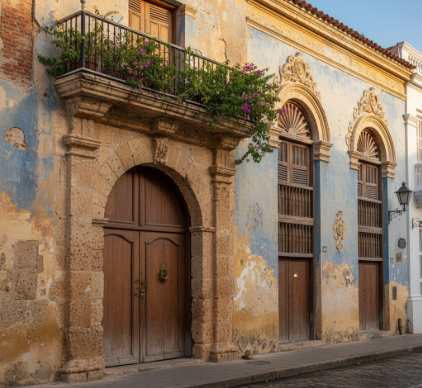
Perhaps the most iconic feature of Cartagena’s streetscape is the wooden balcony. Elaborately carved and often overflowing with cascades of pink and purple bougainvillea, they seem to be everywhere. These are not just aesthetic additions. The large, covered balconies were essential for life in the tropics before air conditioning. They shade the street and the building’s lower level, keeping the intense sun from baking the walls. More importantly, they were designed to capture the sea breeze and funnel it towards the windows and doorways, creating natural ventilation. They also served as a social space, a semi-private perch from which residents could watch the world go by, a tradition that continues to this day.
The Secret World of the Courtyard
From the outside, a colonial house in Cartagena can appear solid and imposing, with heavy wooden doors and few ground-floor windows. But step inside one of these doors, and you enter another world entirely. The heart of the colonial home is the
patio, or interior courtyard. This open-air space, often filled with lush tropical plants, palm trees, and a trickling fountain, was the home’s primary source of light and air. The rooms of the house were all arranged around this central courtyard, with large, open-air walkways or galleries connecting them. This design allowed for cross-ventilation throughout the entire structure, letting hot air rise and escape while drawing in cooler air from below. The courtyard was a private oasis, a cool and tranquil escape from the heat and noise of the city streets.
Defining Elements of Style
While adapted for the Caribbean, the architectural DNA of Cartagena is distinctly Spanish, specifically Andalusian. The Moorish influences that shaped southern Spain are clearly visible in Cartagena’s design philosophy.
Thick Walls and High Ceilings: The coral stone and masonry walls of the buildings are incredibly thick, sometimes several feet. This provides immense thermal mass, meaning they absorb the day’s heat very slowly, keeping the interiors relatively cool. This is complemented by soaring high ceilings, often with exposed dark wood beams, which allow hot air to rise far above the living space, further enhancing comfort.
Grand Doorways and Windows: Doors are typically massive, made of dark, heavy wood and often decorated with intricate iron or bronze knockers, known as
aldabas. The size and complexity of the aldaba—shaped like lizards, sea creatures, or lions—were once used to signify the social standing and profession of the family that lived within. Large, shuttered windows, protected by wooden or iron grilles, were also key to managing light and airflow.
Today, Cartagena’s colonial architecture is not a relic frozen in time. These centuries-old buildings are very much alive, repurposed as boutique hotels, world-class restaurants, vibrant shops, and beloved family homes. The city has managed to preserve its physical heritage while infusing it with modern life, creating a destination that is both historically profound and wonderfully alive. It is a testament to the fact that great design is timeless, and that the buildings of Cartagena were built not just to defend against cannonballs, but to gracefully embrace the Caribbean itself.