Step through the doorway of a traditional Irish pub on any given night, and you might be greeted by a scene that feels both timeless and vibrantly alive. Past the clinking glasses and the low hum of conversation, tucked away in a corner, is the source of the pub’s true energy. It’s not a stage, there are no spotlights, and there’s no formal announcement. This is a session, or a
seisiún ceoil, and it is the living, breathing heart of Irish culture, a powerful expression of community spirit that transcends mere musical performance.
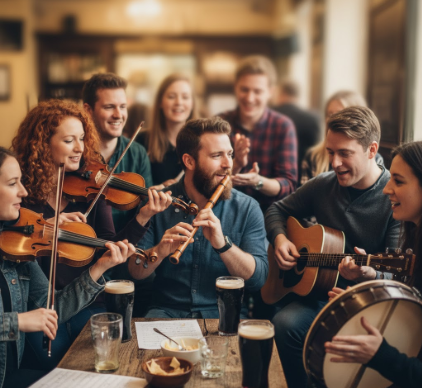
Forget what you might think of as a concert. A session is not a show put on for a passive audience. It is a gathering, a conversation conducted through melody and rhythm. Musicians sit in a rough circle, their instruments a familiar extension of themselves. You’ll see fiddles tucked under chins, the low, mellow glow of a wooden flute, the complex machinery of the uilleann pipes, and the steady, primal heartbeat of a bodhrán, the traditional Irish frame drum. There is no setlist, no conductor, only a shared language of tunes passed down through generations.
The Unspoken Dialogue of Music
To the uninitiated, the start of a tune can seem almost magical, as if born from thin air. One musician, perhaps with a subtle nod or a quick intake of breath, will launch into the opening bars of a jig or a reel. Within moments, like a spark catching on dry tinder, others join in. The melody swells, harmonies interweave, and the rhythm takes hold of the room. This is communication at its most fundamental level. It’s a dance of listening and responding, of giving space and taking the lead, all communicated through subtle glances and the shared understanding of a vast, unwritten repertoire.
The musicians aren’t just playing notes; they are telling stories. The tunes themselves carry the history of the land—tales of celebration, sorrow, love, and rebellion. A lively reel might evoke the energy of a country dance, while a slow, haunting air can conjure images of mist-covered hills and ancient melancholy. The session is where these stories are kept alive, not as dusty relics in a museum, but as vital, dynamic expressions of a shared heritage.
In this intimate setting, the line between performer and audience blurs into nonexistence. While the musicians are the core of the session, everyone in the pub plays a part. The rhythm is infectious. You’ll see it in the tapping feet of the old man by the fire, in the subtle swaying of the couple at the bar, and in the spontaneous clapping that might erupt at the close of a particularly energetic set of tunes. This collective energy feeds back to the musicians, creating a symbiotic loop of enthusiasm and appreciation.
The session is a great social leveler. In that musical circle, a doctor might be sitting next to a farmer, a student next to a retired carpenter. Social status, wealth, and age become irrelevant. The only thing that matters is the music and the shared moment. It’s a space where strangers can become friends over a shared love for a melody, and where the community reinforces its bonds week after week. It’s a reminder that we are all connected by something more profound than our daily routines.
An authentic Irish session operates on a foundation of mutual respect and unspoken rules. It is not an open mic night; musicians join by invitation or a subtle nod from established players. The primary focus is on the collective sound, not individual showmanship. Listening is as crucial a skill as playing, ensuring the music flows as a cohesive whole. This etiquette preserves the session as a genuine cultural gathering rather than a tourist spectacle.
A Living, Evolving Tradition
One of the most beautiful aspects of the pub session is its role in the transmission of culture. Many of the tunes played have been around for hundreds of years, passed down not through formal lessons or sheet music, but aurally—from person to person, generation to generation. A young fiddler learns by sitting in, listening intently, and gradually picking up the melodies from their elders. It’s an apprenticeship that happens organically, right there in the warmth and camaraderie of the pub.
This method ensures that the tradition never becomes static. While the core melodies remain, each musician adds their own unique ornamentation and style. The music is constantly being reinterpreted, infused with new life and personal expression. A session is therefore not a sterile recreation of the past; it is the past and present converging in a dynamic and ever-changing musical conversation. It honors its roots while continuing to grow and evolve.
Finding the ‘Craic’
To truly understand the spirit of a session, one must understand the Irish concept of
“craic”. This word, though often translated simply as “fun,” encompasses so much more. It’s about lively conversation, good humor, and a deep sense of connection and conviviality. The music is the perfect catalyst for the craic. In the pauses between sets of tunes, the pub is filled with laughter, storytelling, and friendly banter. The shared experience of the music opens people up, making it easy to strike up a conversation with a complete stranger.
The craic is the intangible atmosphere that makes a session so special. It’s the feeling of being part of something larger than yourself. It’s the warmth of the community, the joy of the music, and the sense of belonging that permeates the room. An Irish pub session is more than just a musical event; it is a profound act of community building, a celebration of heritage, and a powerful reminder of the human need to connect through shared culture and art. To experience it is to witness a tradition that is not just surviving, but thriving in the heart of its community.