When we cast our minds back to the ancient world, the narrative is often dominated by Rome, Greece, and Egypt. Africa, in this common telling, is frequently represented solely by the golden sands and monumental pyramids of the pharaohs. But this picture is woefully incomplete. South of the Sahara, and even right next door to Egypt itself, a vibrant tapestry of kingdoms and empires flourished, boasting advanced cultures, sprawling trade networks, and incredible architectural achievements. These are not mere footnotes in history; they were powerful civilizations whose legacies are slowly being pieced back together, challenging long-held assumptions about the continent’s past.
Whispers of Power Along the Nile and Beyond
The story of these overlooked realms often begins where the popular history of Egypt ends: at its southern border. Here, in the region known as Nubia (modern-day Sudan), rose a formidable power that was both a rival and, at times, a ruler of Egypt itself: the Kingdom of Kush.
The Kingdom of Kush: The Land of the Black Pharaohs
For centuries, the relationship between Egypt and Kush was complex, a dance of trade, cultural exchange, and military conflict. While often depicted as a lesser neighbor, Kush was a sophisticated civilization with its own distinct culture, language (Meroitic), and traditions. Its early capital at Kerma was one of the first urban centers in sub-Saharan Africa. Later, the capital moved to Napata and then to the great city of
Meroë.
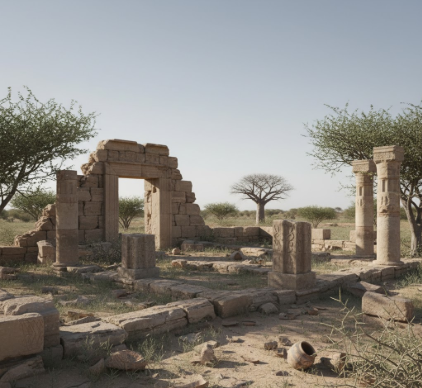
Meroë became the heart of a thriving empire. It was a major center for iron production, with so many furnaces that the slag heaps are still visible today, earning it the nickname “the Birmingham of ancient Africa.” This mastery of iron gave Kush a significant military and economic advantage. The Kushites also built their own pyramids to house the tombs of their royals. While inspired by Egyptian design, the Nubian pyramids are strikingly different: narrower, with much steeper sides, and more numerous than those in Egypt. They stand today as a silent testament to a dynasty that was powerful enough to turn the tables on its famous northern neighbor.
It is a verified historical fact that the Nubian kings of Kush, known as the ‘Black Pharaohs,’ conquered and ruled over the entirety of Egypt for nearly a century as the 25th Dynasty. This period is recognized as a time of renaissance in Egypt, where Kushite rulers revived ancient religious traditions and commissioned extensive building projects along the Nile. This powerful legacy directly challenges the narrative of Egypt existing in isolation from its southern neighbors.
The Kingdom of Aksum: A Global Trade Hub
As Kush began to decline, another great power was rising in the highlands of modern-day Ethiopia and Eritrea. The Kingdom of Aksum was a maritime and trading titan whose influence stretched far beyond the African continent. Strategically located to control trade routes on the Red Sea and the Indian Ocean, Aksum became a crucial link between the Roman Empire and the distant markets of India and Ceylon. Ivory, gold, tortoise shells, and spices flowed through its bustling port of Adulis.
Aksum’s wealth and global standing were immense. It was one of the first civilizations in the world to mint its own coins, inscribed in Greek and the native script of Ge’ez. The Aksumites were also master engineers, best known for their colossal stelae—single-piece granite obelisks carved to represent multi-story buildings, with false doors and windows. The largest of these, the Great Stele, would have stood over 33 meters high and weighed more than 500 tons, making it one of the largest single pieces of stone ever worked by humans in the ancient world. In the 4th century CE, under
King Ezana, Aksum embraced Christianity, becoming one of the first empires in the world to do so, a faith that continues to define the region to this day.
Great Zimbabwe: The Stone Metropolis of the South
Deep in Southern Africa, far from the influence of the Mediterranean and Red Sea, another enigmatic and powerful kingdom emerged. The civilization of Great Zimbabwe, which flourished between the 11th and 15th centuries, left behind the most impressive ancient ruins in sub-Saharan Africa. The name itself means “great houses of stone,” and the site is dominated by massive, mortarless stone walls that form intricate enclosures, the most famous being the Great Enclosure with its mysterious Conical Tower.
For decades, colonialist historians refused to believe that such sophisticated structures could have been built by native Africans, attributing them to everyone from the Phoenicians to the Queen of Sheba. Archaeological evidence has since proven conclusively that they were the work of the ancestral Shona people. Great Zimbabwe was the capital of a vast state and sat at the center of an extensive trade network that moved gold from the interior plateaus to the coastal ports of the Indian Ocean. Artifacts found at the site, including Chinese porcelain, Persian pottery, and Arab coins, reveal its connection to a global economy. The sheer scale and artistry of the stonework point to a highly organized, prosperous society with a complex social hierarchy. The reasons for its eventual decline and abandonment remain a topic of debate, with theories ranging from climate change to a shift in trade routes, but its silent walls continue to speak of the incredible ingenuity of its builders.
These kingdoms—Kush, Aksum, and Great Zimbabwe—are just a few of the many complex societies that thrived in ancient Africa. From the terracotta artists of the Nok civilization in West Africa to the merchants of the Ghana Empire, the continent’s history is rich, diverse, and profoundly deep. By looking beyond the familiar, we uncover a more complete and fascinating story of our shared human past, one that is still being unearthed.