The Music and Passion of Buenos Aires Argentina

The Music and Passion of Buenos Aires Argentina World Culture
To walk through Buenos Aires is to walk through a living melody. The city doesn’t just have a soundtrack; it has a soul that expresses itself in rhythm and harmony. It’s in the distant, melancholic sigh of a bandoneón drifting from a half-open window in San Telmo, the passionate strum of a guitar in a Palermo café, and the defiant beat of rock music echoing from a basement club. This is a city built on passion, nostalgia, and a fierce sense of identity, and its music is the most honest language it speaks. The spirit of the Argentine capital is a complex tapestry woven from threads of European longing and Latin American fire. Its people, the Porteños, live their lives with an intensity that can be startling to outsiders. Love, heartbreak, political debate, and football are not casual interests; they are all-consuming passions that fuel the city’s creative engine. This emotional candor finds its ultimate expression in the music that has defined Buenos Aires for over a century: the tango.

The Soul of the City: The Birth of Tango

Tango is more than just a dance; it is a philosophy, a tragic thought that can be danced. It was born in the late 19th century in the gritty port districts of La Boca and Barracas. This was a world of immigrants, primarily from Italy and Spain, mixed with descendants of African and native peoples. In the crowded tenements and dimly lit bars, these disparate cultures collided, sharing their music, their sorrows, and their yearning for a life left behind. From this melting pot of Italian melodies, Spanish flamenco, African candombe rhythms, and Cuban habanera, a new, raw sound emerged.

The Sound of Longing

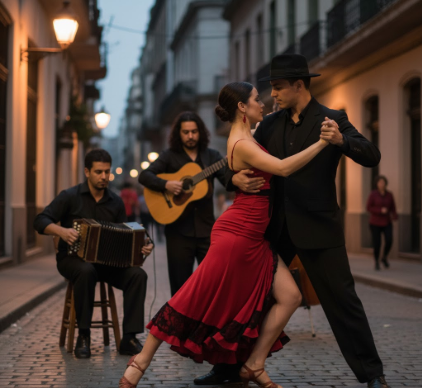
At the heart of the tango sound is the bandoneón. This German-made concertina, often mistaken for an accordion, is said to be the very voice of tango. Its sound is profoundly melancholic, capable of expressing a deep, gut-wrenching sadness in one moment and a sharp, defiant anger in the next. It breathes with the music, its bellows expanding and contracting like a chest taking a painful breath. Accompanied by the violin’s weeping strings, the rhythmic foundation of the piano, and the deep pulse of the double bass, the bandoneón tells stories of lost love, betrayal, and the bittersweet ache of nostalgia.

From the Underworld to the World Stage

Initially, tango was the music of the working class and the underworld, confined to brothels and seedy dance halls where men would dance with each other while waiting for a female partner. The upper echelons of Porteño society looked down on it as vulgar and improper. Its fortunes changed dramatically when it was exported to Paris in the early 20th century. The French aristocracy was captivated by its raw sensuality and dramatic flair. Suddenly, tango was chic. It was polished, refined, and sent back to Buenos Aires as a cultural treasure. Figures like the legendary singer Carlos Gardel became international superstars, his velvety voice embodying the romantic ideal of the tango crooner and cementing the music’s place as Argentina’s greatest cultural export.

Where the Music Lives and Breathes

Experiencing music in Buenos Aires is an immersive activity. It’s not something you passively observe; you feel it in the cobblestones and see it in the faces of the people. For the tango aficionado, the city offers a spectrum of experiences, from slick, choreographed stage shows to intimate, authentic social gatherings.

The Milonga: A Social Ritual

To find the true heart of tango, one must visit a milonga. These are not tourist shows but traditional dance halls where local Porteños of all ages gather to dance. A milonga is a world of unspoken rules and subtle etiquette. Dancers are organized into lanes that move counter-clockwise around the floor. Partners are chosen not with a spoken invitation but with a nod and a meaningful glance from across the room, a practice known as the cabeceo. Here, the dance is an intimate, improvised conversation between two people, a shared moment of connection that is both personal and communal. The atmosphere is one of profound respect for the music and the dance.
Tango’s immense cultural significance was officially recognized on a global scale. In 2009, UNESCO inscribed Tango on the Representative List of the Intangible Cultural Heritage of Humanity. This designation celebrates it as a symbol of the city of Buenos Aires and a unique expression of cultural fusion and identity.


Spectacle and Street Performance

For those seeking a more theatrical experience, the city is famous for its dazzling tango dinner shows. Venues like Esquina Carlos Gardel or Rojo Tango offer breathtaking performances with world-class dancers, live orchestras, and gourmet food. These shows capture the dramatic, passionate spirit of tango as a performance art. Yet, some of the most charming encounters with the dance happen spontaneously. On a Sunday afternoon in the San Telmo market or along the colorful Caminito street in La Boca, you’ll find couples dancing on the pavement for tips, their movements a raw and beautiful testament to the music’s enduring power in everyday life.

A City of Many Rhythms

While tango is the city’s most famous musical ambassador, the sonic landscape of Buenos Aires is far richer and more diverse. The passion of the Porteños is not limited to a single genre.

The Roots of Folklore

Away from the urban intensity of tango, the traditional music of Argentina’s countryside, known simply as folklore, holds a special place in the city’s heart. Genres like the lively chacarera and the romantic zamba are celebrated in clubs called peñas. These are warm, communal gatherings where people share food, wine, and song, often breaking out into spontaneous folk dances. It’s a sound that connects the city back to the vast plains and mountains of the nation.

The Voice of a Generation: Rock Nacional

Since the 1960s, Buenos Aires has been a powerhouse of Spanish-language rock music, known as Rock Nacional. This genre became a crucial voice of social and political protest, especially during the military dictatorship of the 1970s and 80s. Artists like Charly García and Luis Alberto Spinetta are revered as national poets, their music blending rock and roll with distinctly Argentine lyrical sensibilities. The rock scene today remains vibrant, a testament to the city’s rebellious and forward-looking spirit. Ultimately, the music of Buenos Aires is the city’s biography written in notes and rhythms. It’s a story of struggle, resilience, and an unwavering belief in the power of passion. To listen to the music of Buenos Aires is to understand the heart of its people—a heart that beats with the dramatic pulse of tango, the earthy rhythm of folklore, and the defiant energy of rock and roll.
Dr. Anya Petrova, Cultural Anthropologist and Award-Winning Travel Writer

Dr. Anya Petrova is an accomplished Cultural Anthropologist and Award-Winning Travel Writer with over 15 years of immersive experience exploring diverse societies, ancient civilizations, and contemporary global phenomena. She specializes in ethnocultural studies, the impact of globalization on local traditions, and the narratives of human migration, focusing on uncovering the hidden stories and shared experiences that connect humanity across continents. Throughout her career, Dr. Petrova has conducted extensive fieldwork across six continents, published critically acclaimed books on cultural heritage, and contributed to documentaries for major educational networks. She is known for her empathetic research, profound cultural insights, and vivid storytelling, bringing the richness and complexity of global cultures to life for a broad audience. Dr. Petrova holds a Ph.D. in Cultural Anthropology and combines her rigorous academic background with an insatiable curiosity and a deep respect for the world's diverse traditions. She continues to contribute to global understanding through her writing, public speaking, and advocating for cultural preservation and cross-cultural dialogue.

Rate author
OneStopCool: Global Culture & Exploratio
Add a comment