Content
The Gilded Man of the Muisca
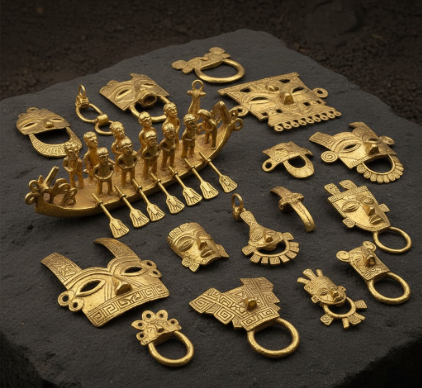
To find the seed of the legend, we must travel back in time, not to a mythical empire, but to the high-altitude plains of the Andes in modern-day Colombia. Here lived the Muisca people, one of the four great civilizations of the Americas, alongside the Aztec, Maya, and Inca. They were master craftsmen, particularly renowned for their exquisite goldwork. For the Muisca, however, gold was not a symbol of currency or material wealth in the European sense. It held a deeper, spiritual significance. It was an offering to the gods, a sacred metal that reflected the life-giving power of the sun. At the heart of their society was a spectacular and sacred ritual that took place at Lake Guatavita. When a new chieftain, or *zipa*, was to be initiated, he became the central figure in a ceremony of immense religious importance. This was the true El Dorado—”The Gilded Man.” The new leader would be stripped naked, and his body would be coated in a sticky resin, over which fine gold dust was blown until he shone like a living statue of the sun god. He was transformed into a physical offering.The legend of El Dorado originated not with a city, but with a Muisca ritual. A new chieftain, known as “The Gilded Man,” would have his body covered in gold dust. He would then travel to the center of Lake Guatavita on a raft and offer gold and emeralds to the gods by casting them into the water. This ceremony was the factual basis for the much larger myth of a lost city of gold.The Gilded Man would then be taken to the center of the sacred lake on a ceremonial raft, accompanied by other high-ranking priests. The raft was laden with treasures—intricately crafted gold figures, known as *tunjos*, and precious emeralds. As the sun rose over the Andes, the new chieftain would dive into the cold, dark water, washing the gold from his body as a purifying act. Simultaneously, he and his attendants would cast the treasures into the lake as offerings to the gods who dwelled in its depths. The shores would be lined with his people, who would celebrate with music and fires. This was not an act of waste; it was a profound act of spiritual renewal and a reaffirmation of the cosmic balance.
From Ritual to Rumor: The Conquistador’s Fever Dream
This sacred Muisca tradition was fated to be misinterpreted in the most destructive way possible. When the Spanish conquistadors arrived in the early 16th century, they were driven by a single, all-consuming desire: gold. They heard fragmented stories from local tribes about a leader who covered himself in gold and threw it away. To the European mind, obsessed with accumulation and wealth, this was incomprehensible. Such an act could only mean one thing: that the source of this gold must be so vast, so unimaginably rich, that it could be disposed of with such casual extravagance. The story of the Gilded Man was retold and exaggerated, passed from one ambitious explorer to another. The man became a king, the ritual became a daily occurrence, and the lake became the gateway to a hidden kingdom. The legend of El Dorado was born, transforming from a golden man into a golden city, and eventually, a whole golden empire. This phantom city became the ultimate prize, a justification for any cruelty and a beacon for the most reckless of expeditions.The Obsessive and Bloody Quests
The hunt for El Dorado became one of history’s most infamous and tragic wild goose chases. It drew a succession of ruthless and determined men into the uncharted and hostile interior of South America, leaving a trail of destruction in their wake. One of the first major expeditions was led by Gonzalo Jiménez de Quesada in 1536. He marched his men through brutal jungles and swamps, eventually reaching the Muisca territory. He conquered them, plundered their cities, and seized a vast amount of gold, but he never found the mythical city. His “discovery,” however, only fueled the rumors further. Soon after, other conquistadors like Sebastián de Belalcázar and the German Nikolaus Federmann converged on the same area, all drawn by the same glittering promise. The legend was now firmly established, but its location remained frustratingly elusive. As each expedition failed to find it in the Colombian highlands, the supposed location of El Dorado was pushed further and further east, deep into the vast, unexplored Amazon basin. Perhaps the most disastrous quest was that of Gonzalo Pizarro, the half-brother of the man who conquered the Incas. In 1541, he set out from Quito with hundreds of Spaniards and thousands of indigenous porters. The expedition was an unmitigated nightmare. They endured starvation, disease, and constant attacks. A desperate Pizarro sent his lieutenant, Francisco de Orellana, downriver in search of food. Orellana and his men were swept away by the current and, in a remarkable feat of survival, ended up navigating the entire length of the Amazon River to the Atlantic Ocean. They never found El Dorado, but their journey permanently shifted the myth’s location to the Amazonian wilderness.Sir Walter Raleigh and the City of Manoa
The legend eventually captivated the English as well, most famously in the person of Sir Walter Raleigh. Convinced that El Dorado, which he called Manoa, was located in the highlands of Guyana, he led two expeditions in 1595 and 1617. Raleigh was a romantic and a scholar as much as an adventurer. He believed Manoa was a city “that for the greatness, for the riches, and for the excellent seat, it far exceedeth any of the world.” He failed to find his city of gold. His first expedition yielded little, and his second was a political and personal disaster that directly led to a conflict with the Spanish and his own execution upon his return to England. Yet, his widely-read book, *The Discoverie of the Large, Rich, and Bewtiful Empyre of Guiana*, immortalized the legend in the English-speaking world, ensuring its survival for centuries to come.The pursuit of El Dorado was a catastrophic endeavor. Expeditions led by figures like Gonzalo Pizarro and Sir Walter Raleigh resulted in immense suffering and death for both Europeans and indigenous peoples. These quests were not just failures in exploration; they were humanitarian disasters driven by greed, which led to the destruction of cultures and the loss of countless lives in the unforgiving South American wilderness.