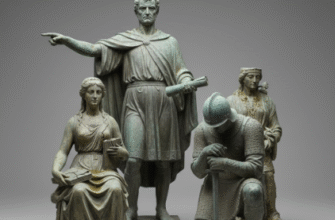
The name Cleopatra conjures a very specific image: a sultry Egyptian queen, draped in gold and jewels, using her legendary beauty to seduce the most powerful men in the world. We picture Elizabeth Taylor with her iconic kohl-rimmed eyes, a femme fatale whose romantic entanglements toppled empires. This image, however, is largely a work of fiction, a masterful piece of character assassination crafted by her enemies and later embellished by centuries of art, plays, and Hollywood films. The real Cleopatra VII Philopator was far more formidable and fascinating than the caricature she has become. She was not primarily a seductress, but a brilliant intellectual, a shrewd politician, and a ruthless ruler who fought to preserve her kingdom against the encroaching might of Rome.
A Scholar Queen, Not a Foreign Temptress
To understand Cleopatra, one must first discard the notion that she was Egyptian. She was, in fact,
Macedonian-Greek, the last ruler of the Ptolemaic dynasty, a lineage descended from Ptolemy I Soter, one of Alexander the Great’s most trusted generals. For nearly 300 years, her family ruled Egypt, but they remained culturally and linguistically Greek, often refusing to even learn the language of their subjects. Cleopatra was a remarkable exception. Polyhistor Plutarch wrote that she rarely required an interpreter. This was not a minor talent; it was a powerful political tool.
Her intellect was her true superpower. Raised in Alexandria, the intellectual capital of the ancient world, she received an education that would have been the envy of any male ruler. She studied mathematics, philosophy, oratory, and astronomy. Her fluency in languages was legendary. She was said to speak at least nine, including Egyptian, Ethiopian, Hebrew, Arabic, and Parthian. By speaking directly to her subjects and to foreign emissaries in their own tongues, she bypassed the political distance her predecessors had maintained, fostering loyalty at home and earning respect abroad. This was a ruler who understood that knowledge and communication were instruments of power as sharp as any sword.
Historical records, particularly from Roman scholars like Plutarch, confirm that Cleopatra’s linguistic abilities were exceptional. She was the first Ptolemaic ruler in three centuries to learn the Egyptian language. This allowed her to connect with the native population and priesthood in a way her ancestors never could, solidifying her power base within the kingdom she governed.
The Game of Thrones in Alexandria
Cleopatra’s reign began not with romance, but with a bitter and bloody family feud. She inherited the throne at eighteen, forced to co-rule with her much younger brother, Ptolemy XIII. Almost immediately, powerful court eunuchs and advisors turned her brother against her, forcing her into exile. This is where her story truly begins, not as a passive queen, but as a determined contender fighting for her birthright. She raised a mercenary army and returned to Egypt to wage a civil war. It was at this critical juncture that the Roman general,
Julius Caesar, arrived in Alexandria, pursuing his rival Pompey. Cleopatra saw not a conqueror, but an opportunity.
The famous story of her being smuggled to Caesar rolled up in a carpet is often presented as a seductive ploy. In reality, it was a daring and audacious move born of desperation and strategic genius. She was surrounded by her brother’s forces and had no other way to reach the Roman general who now held the balance of power in his hands. The move showcased her courage and her flair for the dramatic—qualities that would define her reign. She presented herself not as a supplicant, but as the rightful ruler of Egypt, making a powerful first impression on a man who appreciated boldness. Their alliance was a pragmatic one: Caesar needed Egypt’s vast wealth to pay his armies, and Cleopatra needed Caesar’s legions to defeat her brother and secure her throne.
Rome’s Most Powerful Partner
The relationship that developed between Cleopatra and Caesar was more than a mere affair; it was a powerful political partnership. She was not his puppet. She spent time in Rome as a visiting head of state, living in one of Caesar’s country villas. Her presence caused a stir, but she was there to observe and learn, solidifying her kingdom’s status as a key Roman ally. She gave birth to his only known son, Ptolemy XV Caesar, nicknamed
Caesarion, or “Little Caesar.” This child was a living symbol of their alliance and, in Cleopatra’s eyes, the potential heir to a vast Greco-Roman empire.
Caesar’s assassination in 44 BCE threw Cleopatra’s world into chaos once more. Her Roman protector was gone, and she had to navigate the treacherous power vacuum that followed. She returned to Egypt and once again played a careful game, consolidating her power and waiting for the dust to settle in Rome. When it did, two men remained standing: Caesar’s heir, Octavian, and his most trusted general, Mark Antony. Cleopatra once again had to choose a side to ensure Egypt’s survival.
The Master of Political Theatre
Her meeting with Mark Antony is another moment that has been romanticized to the point of cliché. Antony summoned her to Tarsus to answer for her supposed support of Caesar’s assassins. Instead of arriving as an accused subordinate, Cleopatra turned the tables with a stunning display of power and propaganda. She sailed up the River Cydnus on a magnificent golden barge with purple sails and silver oars, rowed by servants dressed as cupids. She herself was dressed as the goddess Venus, reclining under a golden canopy. It was a calculated spectacle designed to awe Antony and showcase the unimaginable wealth of Egypt. She wasn’t just meeting a general; she was the goddess of love arriving to meet the god of wine, Dionysus, with whom Antony identified. It was a masterclass in public relations, and it worked perfectly. Antony was enchanted, not just by her, but by the power and prestige she represented.
Their alliance was both personal and political. They shared a genuine affection and had three children together. But they also shared a grand geopolitical vision: to create a powerful Eastern empire, with Alexandria as its capital, that could rival Rome itself. This ambition was ultimately their undoing, as it provided the perfect weapon for their rival back in Rome.
The Propaganda War and the Final Defiance
In Rome, Octavian watched the growing power of Antony and Cleopatra with alarm. He could not attack Antony directly, as he was a popular Roman hero. So he attacked Cleopatra. Octavian launched one of history’s most effective smear campaigns, painting Cleopatra as a decadent foreign witch who had used sex to ensnare a noble Roman. He portrayed her as a threat to Roman values, a debauched Eastern monarch who sought to rule over them. This propaganda was incredibly effective, turning Roman public opinion against Antony and giving Octavian the justification he needed for war.
The decisive confrontation came at the naval Battle of Actium in 31 BCE. The defeat of Antony and Cleopatra’s forces was catastrophic. They fled back to Egypt, with Octavian’s legions in hot pursuit. Faced with certain capture, Antony took his own life. Octavian’s goal was to capture Cleopatra and parade her through the streets of Rome in a triumphal procession—the ultimate humiliation for a defeated monarch. But Cleopatra would deny him his prize. Her suicide, famously attributed to the bite of an asp smuggled to her in a basket of figs, was her final act of defiance. By choosing the manner and time of her own death, she seized control of her narrative one last time, ensuring she would be remembered not as a chained captive, but as a queen who refused to be broken. She ruled for 22 years, longer than most of her male predecessors, and she was the last pharaoh of Egypt. Her death marked the end of an era and the final absorption of her great kingdom into the Roman Empire.