Content
The Architect of Worlds
Before they are anything else, volcanoes are builders. The very ground we stand on is, in large part, a product of volcanic activity over geological time. Entire island chains, like the Hawaiian archipelago, owe their existence to undersea volcanoes that breached the ocean’s surface after millions of years of eruptions, building layer upon layer of solidified lava until new land was born from the sea. These shield volcanoes, with their gentle, sprawling slopes, are a testament to the patient, constructive power of lava flows. But the creative force of a volcano extends beyond just building mountains. The ash that billows from an eruption, often seen as a destructive nuisance, is one of nature’s most potent fertilizers. Rich in minerals like potassium, phosphorus, and other trace elements, volcanic soil is incredibly fertile. This is why, paradoxically, some of the most densely populated agricultural regions in the world are situated in the shadow of active volcanoes. The slopes of Mount Vesuvius in Italy, for example, have been cultivated for millennia, producing famously delicious fruits and vegetables, all thanks to the life-giving properties of the very thing that once buried Pompeii.A Palette of Fire and Earth
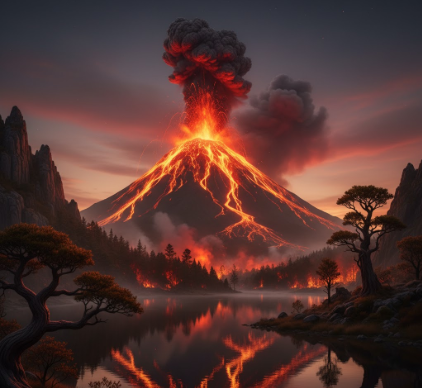
The beauty of a volcano is not just in its grand scale but also in its intricate details. They are nature’s abstract artists, painting the land with a palette of extraordinary colors. In Yellowstone National Park, geothermal activity linked to its supervolcano creates hot springs and geysers with vibrant rings of color—yellows, oranges, and greens—produced by thermophilic bacteria that thrive in the mineral-rich, scalding water. In the Danakil Depression in Ethiopia, the Dallol volcano creates a landscape that looks like it belongs on another planet, with brilliant yellow sulfur fields, turquoise acid pools, and rust-red mineral deposits. Even the eruption itself holds a terrifying beauty. The sight of a Strombolian eruption at night is mesmerizing, with incandescent fountains of lava arcing through the darkness. The Kawah Ijen volcano in Indonesia offers an even more surreal spectacle: a volcano that emits electric-blue flames. This is not blue lava, but rather high-pressure sulfuric gases combusting at extreme temperatures, creating an ethereal, otherworldly glow that flows down the mountainside like a phantom river.The Inevitable Fury
For all its creative power and aesthetic splendor, the deadly nature of a volcano can never be forgotten. The same forces that build mountains can obliterate them in moments. The beauty of a snow-capped stratovolcano like Mount Rainier or Mount Fuji masks an immense destructive potential. These conical volcanoes are built from alternating layers of hardened lava, tephra, and ash, making them prone to explosive eruptions. The dangers are multifaceted. Lava flows, while often slow-moving, are unstoppable juggernauts of molten rock that incinerate everything in their path. More terrifying, however, are the pyroclastic flows. These are superheated, fast-moving avalanches of gas, ash, and rock fragments that can travel at hundreds of kilometers per hour, reaching temperatures of up to 1,000°C. They are impossible to outrun and are one of the most lethal volcanic hazards.It is crucial to understand that a volcano’s apparent dormancy is not a sign of safety. The pressures building deep within the Earth are invisible and can escalate with little to no warning. Pyroclastic flows and lahars (volcanic mudflows) can travel immense distances from the summit, posing a threat to communities that may not even have a direct line of sight to the volcano itself. Respecting exclusion zones and official warnings is not just a recommendation; it is a matter of survival.Volcanic ash, while fertilizing in the long run, is devastating in the short term. Composed of tiny, sharp particles of rock and glass, it can collapse roofs with its weight, contaminate water supplies, and cause severe respiratory problems. Large ash clouds can disrupt global air travel for weeks and even have a temporary impact on the Earth’s climate by blocking sunlight.