Content
The Ever-Living Giants
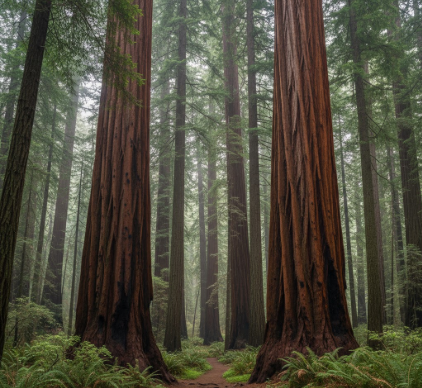
The stars of this ancient forest are the Coast Redwoods, known scientifically as Sequoia sempervirens. The species name itself, translating from Latin, means “ever-living” or “evergreen,” a fitting title for trees that can live for over 2,000 years. These are not to be confused with their cousins, the Giant Sequoias (*Sequoiadendron giganteum*), which are the world’s largest trees by volume and grow in the Sierra Nevada mountains. Coast Redwoods are the slender titans, holding the title for the world’s tallest living things. Their sheer verticality is hard to comprehend. Standing at the base of one, your neck cranes back, and still, the top remains a mystery, lost in the sky-high foliage. Their bark is a marvel in itself—thick, fibrous, and deeply grooved, with a rich cinnamon-red hue. This bark can be up to a foot thick, providing incredible protection against insects and, most importantly, forest fires. It’s a natural fireproof armor that has allowed these trees to survive countless blazes over the centuries.A Kingdom of Titans: The Record Holders
Within the park’s protected boundaries live the tallest trees on Earth. The undisputed champion is a tree named Hyperion, discovered in 2006. It stands at an astonishing 380 feet (115.85 meters) tall, a height that surpasses the Statue of Liberty or a 35-story building. To protect this magnificent specimen and the delicate ecosystem at its base from being trampled by tourism, its exact location is a closely guarded secret.It is crucial for visitors to understand that the exact location of Hyperion is kept secret to protect it from damage. The surrounding ecosystem is incredibly fragile and can be destroyed by foot traffic. Park officials have implemented a strict policy: anyone found in the closed area near the tree faces a potential $5,000 fine and six months in jail. The best way to help preserve these giants is to stay on the marked trails.Hyperion is not alone in its majesty. It’s just one of many “super-trees” in the park, with others like Helios and Icarus also stretching well over 370 feet into the sky. These giants tend to grow in protected valleys and near streams, where they are shielded from the harshest winds and have access to the abundant water and nutrients they need to achieve such staggering heights.
More Than Just Trees: A Complex Ecosystem
The redwood forest is far more than a collection of tall trees; it’s a vibrant, interconnected community. The dense canopy creates a unique microclimate on the forest floor, one of deep shade and high humidity. This environment is perfect for a lush carpet of ferns, mosses, and redwood sorrel. One of the most critical elements of this ecosystem is the coastal fog. During the dry summer months, thick fog rolls in from the Pacific Ocean, blanketing the forest. The redwood needles are uniquely adapted to capture moisture from this fog, which then drips to the forest floor, providing essential water for the trees and all the life below them. This process, known as fog drip, can account for up to one-third of the forest’s annual water intake.Life Among the Giants
This shaded, damp world is home to a fascinating array of wildlife. Listen closely, and you might hear the call of the northern spotted owl or the Steller’s jay. Look down, and you could see a bright yellow banana slug making its slow journey across a fallen log. These fallen giants, known as nurse logs, become cradles for new life, providing nutrients and a stable platform for new seedlings, ferns, and fungi to grow. Even high in the canopy, a complex world exists. The massive branches, hundreds of feet up, can accumulate deep pockets of soil, creating “canopy soils” that support entire communities of plants, insects, and even amphibians that may never touch the ground.A Story of Survival and Preservation
Walking among these ancient beings is like traveling back in time. The oldest redwoods were already saplings when the Roman Empire was at its peak. They have stood silent witness to millennia of history. However, their recent history has been one of peril. The California Gold Rush in the mid-1800s brought a massive influx of settlers who saw the redwoods not as wonders but as an endless supply of timber. Commercial logging began, and over the next century, nearly 95% of the original old-growth redwood forest was cut down. The devastation spurred one of the nation’s earliest and most important conservation movements. In the early 20th century, organizations like the Save the Redwoods League began purchasing tracts of old-growth forest to protect them from the axe. Their efforts, combined with state and federal action, culminated in the establishment of Redwood National Park in 1968, which connected and protected existing state parks. Today, the Redwood National and State Parks (a cooperative management of federal and state lands) protect about half of all remaining old-growth coast redwoods.Redwood National and State Parks is designated as a UNESCO World Heritage Site and an International Biosphere Reserve. This international recognition highlights the global importance of the coast redwood ecosystem. The parks protect not only the tallest trees but also pristine coastline, riverways, and unique cultural resources.